Anthropic and OpenAI just bet big money on implementation, not the model
Corey Berg, Fractional Chief AI Officer
- automation
- process
You have probably had this pitch by now: sign up for a $20 a month AI plan, and it will save your business hours a week. Some of that is true. Most owners who try it end up with a browser tab that helps a little and a business that runs exactly the same as before.
This week, the two companies that make the AI models everyone is pitching told on themselves about why.
What actually changed
On July 15, TechCrunch reported that Anthropic and OpenAI have each spun up a separate business dedicated to putting AI engineers inside their customers' offices to actually build with the technology, not just license it to them.
Anthropic's version is called Ode with Anthropic, a $1.5 billion joint venture with Blackstone, Hellman & Friedman, and a group of other investors including Goldman Sachs, General Atlantic, and Sequoia Capital. It is built on Fractional AI, an applied AI services firm Anthropic acquired back in May, and it now runs about 100 engineers whose job is sitting inside a client's business, figuring out where AI actually fits, and building it. Ode's CEO, Chris Taylor, told TechCrunch: "It's pretty easy to imagine this as a trillion-dollar company someday if we execute well."
Read that number again. The company that makes Claude is not betting its future on people buying more Claude subscriptions. It is betting on people needing help pointing Claude, or any model, at the right problem.
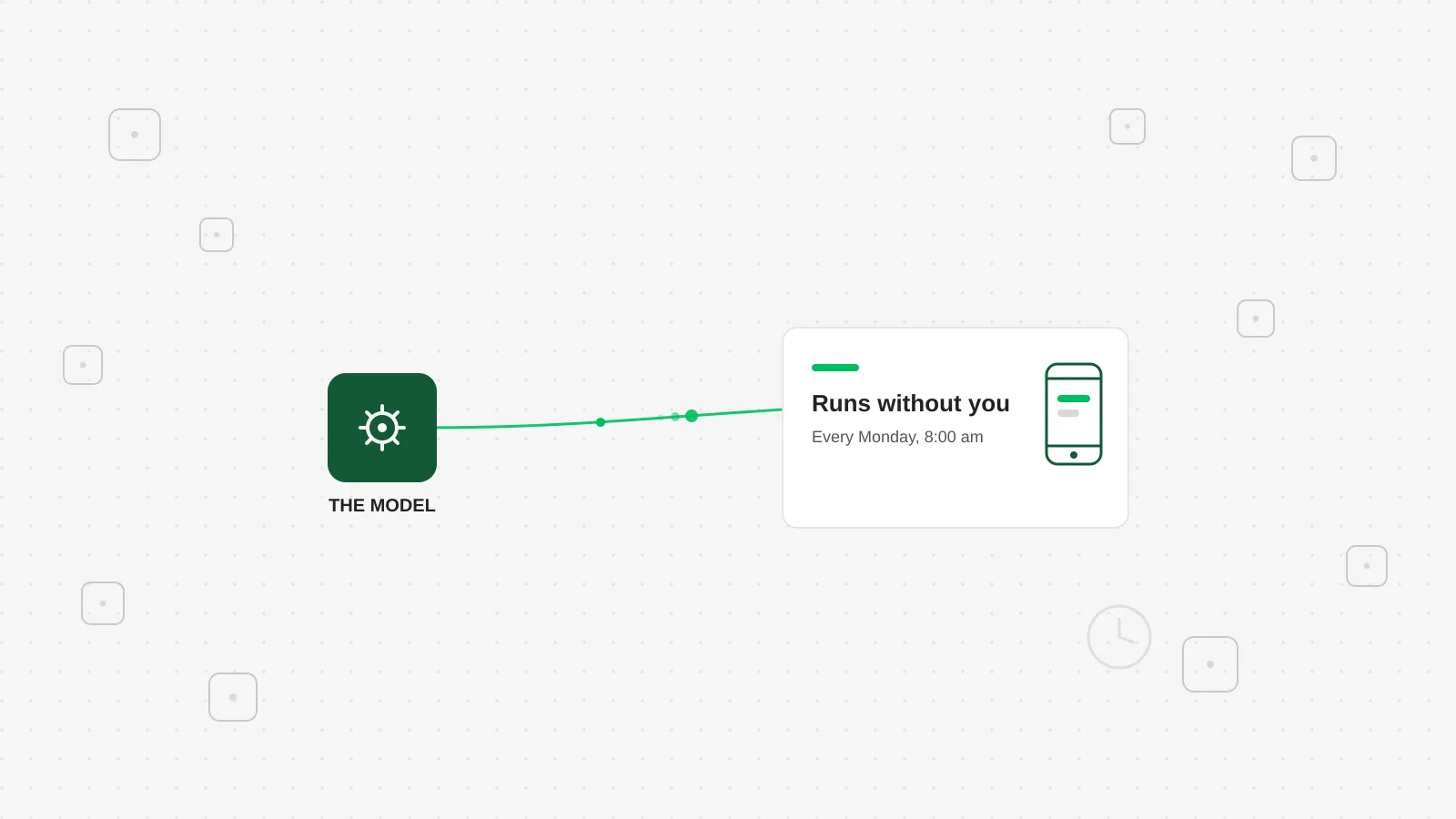 The model is the node on the left. Getting it wired into your actual business is everything to the right of it.
Why this matters even though you are nowhere near Wall Street
Ode's clients are large enterprises, and this deal is not sized for a $1 million to $10 million business. That part of the story is not the point.
The point is what two companies with unlimited engineering budgets and the actual model in-house just told you by spending $1.5 billion: building the model was the easy part. Wiring it into a real business, with real data, real handoffs, and real people who have to trust it, is the part that takes dedicated attention. If the labs that make the tools needed a services company to make their own product land, a subscription alone was never going to do it for your business either.
One detail is worth sitting with. Ode runs "Claude-first," meaning it reaches for Anthropic's own tools before anyone else's, even though it is not required to. That is not a criticism. It is just honest about the incentive. An implementation arm owned by a model maker will lean toward that model maker's model.
The one question that exposes lock-in
If you bring in outside help to put AI to work in your business, whether that is a freelancer, an agency, or a fractional hire, ask them one question before you sign anything: "If your own tool were not the best fit for this job, would you tell me, and would you still recommend it?"
A good answer names a specific case where they picked a different tool than the one they usually sell. A vague answer, or a pivot back to why their tool is great, is the lock-in showing itself. That is exactly the tension a model-agnostic approach exists to avoid: the person building your systems should be free to swap the model underneath them the day a better or cheaper one shows up, without you having to rebuild anything.
The honest math
A $1.5 billion joint venture and 100 engineers is not the comparison that matters to you. This is: a $20 to $200 a month AI subscription and an owner's spare hour on Saturday is not a system, no matter how good the model behind it is.
Say your team is already paying for ChatGPT or Claude seats for four people, at a blended cost of maybe $320 a month. If nobody owns turning any one of those individual habits into something that runs the same way every time, that $320 a month is close to money spent on curiosity, not on a result you can point to. The fix is not a bigger AI budget. It is one person, inside or fractional, whose job is deciding where those tools actually plug into your business and making sure they stay plugged in.
What to do this week
- List which AI tools your team is already paying for, by name and by seat count. Most owners have not added this up in one place.
- For each one, ask whether it is producing a repeatable result or just an occasional convenience. If nobody can answer that in one sentence, nobody owns it yet.
- Before you hire anyone to "implement AI" for you, ask them the lock-in question above, and listen for whether their answer names a real alternative they have actually recommended to someone else.
The model was never going to be the hard part. Deciding what it should be doing in your business, and making sure it keeps doing it, is the job. That is the whole reason a fractional Chief AI Officer role exists in the first place.