Two-thirds of small businesses now use AI. Here is how to get ahead of them.
Corey Berg, Fractional Chief AI Officer
- automation
- process
If you run a business with a few employees and a full inbox, someone near you started using AI this year. Probably a competitor. Probably more than one.
The U.S. Chamber of Commerce just put a number on it, and the number changes what "using AI" is worth.
What the report says
On October 2, the Chamber released the fifth edition of its Empowering Small Business report. The headline: 66% of small businesses now use AI. That is up 8 points from 2025 and close to three times the 23% who used it in 2023.
A few other numbers from the same release, as the Chamber reports them and as local coverage repeats them:
- 47% say AI is creating jobs at their business today. Only 6% say it is letting them cut headcount.
- Small businesses using AI are at least 7 points more likely to report growth in sales, profits, and workforce than those that do not.
- 84% plan to use more technology over the next two to three years.
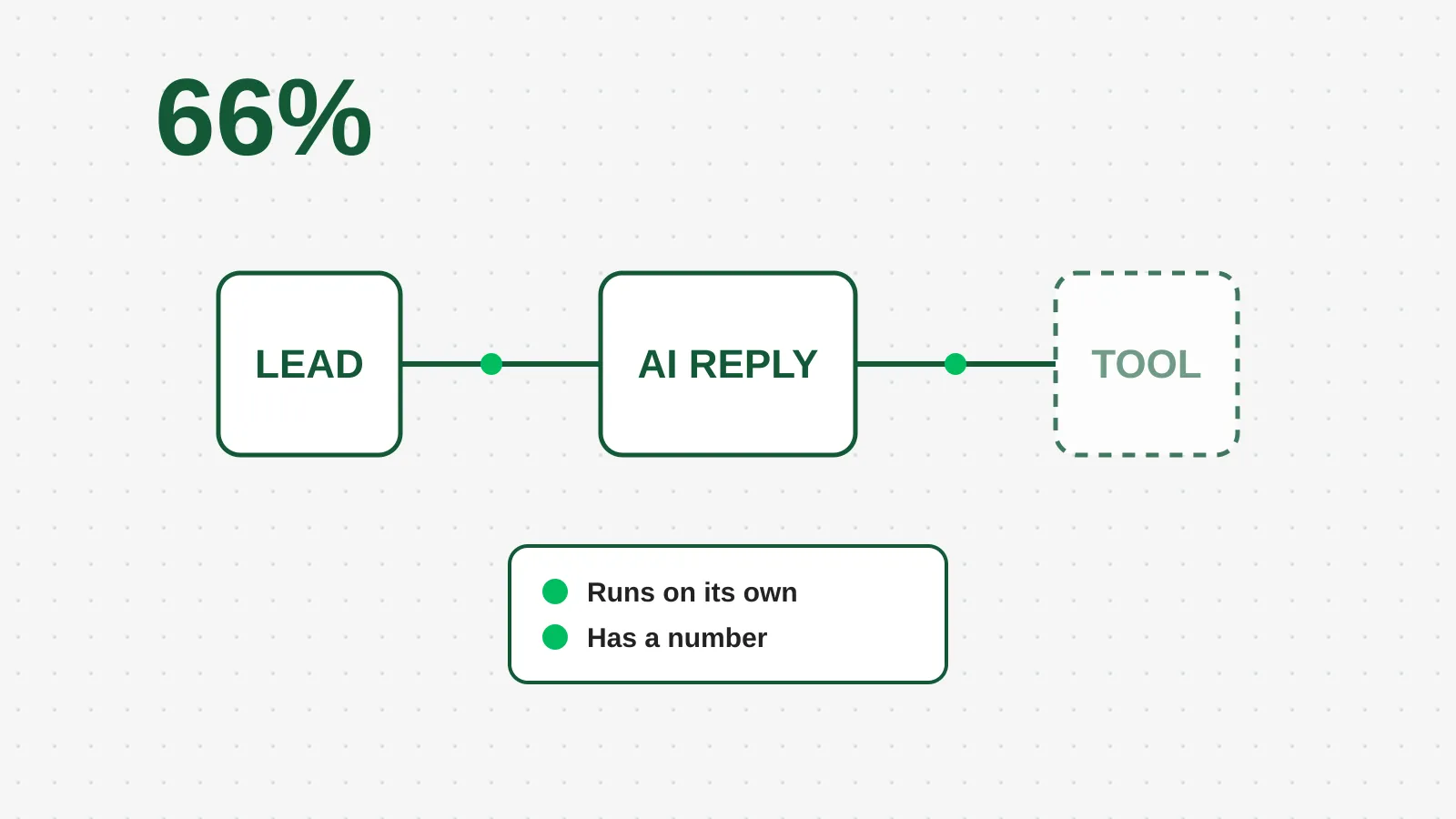 Two of three connected. One is still just a tool someone opens.
What this means for a business like yours
Read the 7-point gap carefully. It compares businesses that use AI with businesses that do not. It does not say that opening ChatGPT twice a week makes your revenue grow. The survey counts adoption, not quality.
That matters because "we use AI" now describes two-thirds of your market. It no longer separates you from anyone. What separates you is whether the AI does a job without a person remembering to start it.
Here is how I tell the difference with a founder-led business. Three questions, about 15 minutes.
1. Does it run when you are not at your desk? If a person has to open a tab and paste something in, it is a tool. If a new lead, invoice, or email triggers it on its own, it is a system.
2. Can you name the job and its number? "We use AI for marketing" fails. "AI replies to every new lead in under a minute" passes. If you cannot say what it did last week, you cannot say whether it works.
3. Does someone own it? Systems break. A form changes, a login expires, a model gets retired. If nobody is named, nobody notices.
Most businesses I talk to answer no to all three on at least half of what they run. That is normal, and it is the reason the Chamber's 66% and the 7-point gap do not tell you much alone.
The honest cost
Turning a tool into a system is not free. Plan on a few hours to wire one trigger to one action in Make, n8n, or your CRM, plus a small monthly bill for the platform and the AI usage. For a single workflow like lead replies, the metered AI cost is often cents per month. Your own time, or someone's you pay, is the real expense.
The other cost is attention. A system with no owner decays, so budget 30 minutes a month to check that it still runs.
What to do this week
List every place your business uses AI today. Next to each, write down the answers to the three questions above.
Pick the one that touches a lead or an invoice and fails the most questions. Fix that one first: give it a trigger, a number, and a name. Do not start a second until the first runs for two weeks without you touching it.
If you have a longer list than time, build the process that touches money before the one that is merely annoying. A missed lead or a late invoice costs you cash. A clumsy internal report costs you patience.
One quiet note: this is the work a fractional Chief AI Officer exists to own, because someone has to be the person in question 3.