What automation actually does for most businesses
Corey Berg, Fractional Chief AI Officer
- automation
- process
Ask most founders what "automation" means and you get something ambitious. An AI agent answering customer questions. A bot that negotiates with vendors. Something that sounds like it belongs in a pitch deck.
That is not what is actually running in most businesses, including the ones I build for. The systems doing the real, daily work are boring on purpose. A lead gets captured. Someone gets told. A record gets made. A record gets updated. That is close to the whole job.
What actually changed
Zapier published an analysis of 20,730,313 live workflows running on its platform as of late June 2026, collapsed into 858,648 distinct automation patterns across 4,302 connected business apps. A pattern here means a trigger plus the actions it sets off, counted independently of which specific apps are doing the work.
Four outcomes dominate. Capturing a lead is the single most common thing automation produces: 257,159 patterns, 29.9% of everything counted. Sending a notification is second at 164,703 patterns, 19.2%. Creating a record is third at 150,853, 17.6%. Updating a record already in a system is fourth at 123,474, 14.4%. Add those four together and you get 81.1% of all automated work in the entire dataset.
Read that again. Four plain actions, not one of them clever, account for four out of every five automations running anywhere on the platform.
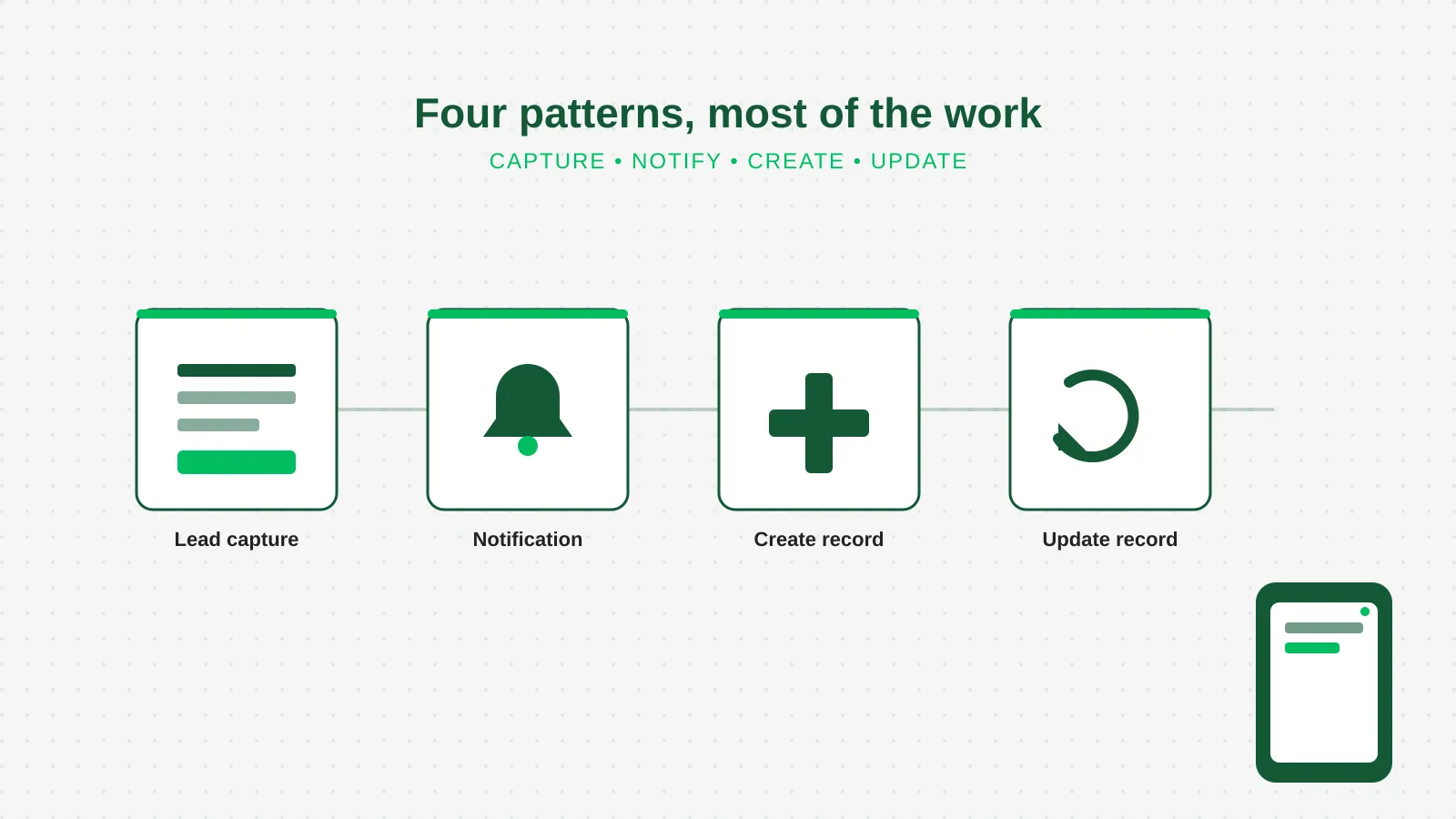 Lead capture, notification, new record, updated record. Four steps, most of the work.
How a founder-led business applies this
None of this is exotic, and that is the point. Map the four patterns to what they look like inside a business your size.
Lead capture is the web form, missed call, or DM that turns into a row in your CRM the second it happens, instead of whenever someone remembers to type it in. This is the same first-minute response work I build under the name speed to lead, and it is not a coincidence that it is also the single most common automation on the planet. Everyone is trying to solve the same problem: do not let the lead go cold while a human gets around to it.
Notification is the text or Slack ping that tells you or your team the moment something needs attention, a new lead, an overdue invoice, a contract that just got signed. No dashboard to remember to check.
Creating a record is the invoice, contract, or onboarding packet that gets generated from a template the moment a deal closes, instead of someone opening a blank document at 9pm.
Updating a record is the status change that happens on its own. A deal marked won, a client moved from onboarding to active, a task closed out, so the system reflects reality without someone having to remember to go fix it.
You do not need a clever AI agent to cover 81% of what automation means in practice. You need these four things wired reliably between the tools you already have.
The honest math
If you can only build one thing this quarter, lead capture is the pick with the best odds by the numbers. It alone is almost a third, 29.9%, of everything counted in a dataset of 20 million live workflows. That is not my opinion, that is where everyone else building automation is already spending their effort.
Nail all four patterns and you are covering the same territory as 81.1% of automated work industry-wide. That is a real ceiling, but a reachable one. None of it requires new software. Every CRM, form tool, and connector platform I use for clients, GoHighLevel, Make, n8n, already does all four natively. For most founder-led businesses, the actual cost is not a subscription. It is the hour or two it takes to wire one trigger to one action, correctly, once.
What to do this week
Pick one process in your business that touches money or a lead. Walk it through the four boxes: does a lead or event get captured automatically, does a person get notified, does a record get created, does a record get updated. Wherever that chain breaks is your best next build, not a fancier AI, just closing the gap between two of these four steps.