What it costs to reply to every new lead with AI
Corey Berg, Fractional Chief AI Officer
- automation
- sales
A lead fills out your form at 9:40 on a Tuesday night. You see it Wednesday at 8:15. By then they have heard from two other companies, and one of them answered in a minute.
Most owners know this and do nothing about it, because the fix sounds expensive. Setting up an AI to reply instantly sounds like a software project with a monthly bill. The bill turns out to be the smallest part.
What OpenAI changed
On September 22, OpenAI released GPT-6 Sol and GPT-6 Luna in ChatGPT Work, Codex, and the API. API pricing is $2 input and $10 output per million tokens for Sol, and $0.10 and $0.50 for Luna. OpenAI describes Sol as the model for demanding everyday work and Luna as the one for high-volume tasks.
It is also a price cut. OpenAI says Sol and Luna cost 50% less than GPT-5.6 promotional pricing.
A token is roughly three quarters of a word. You pay per million of them, in and out. That is the whole meter.
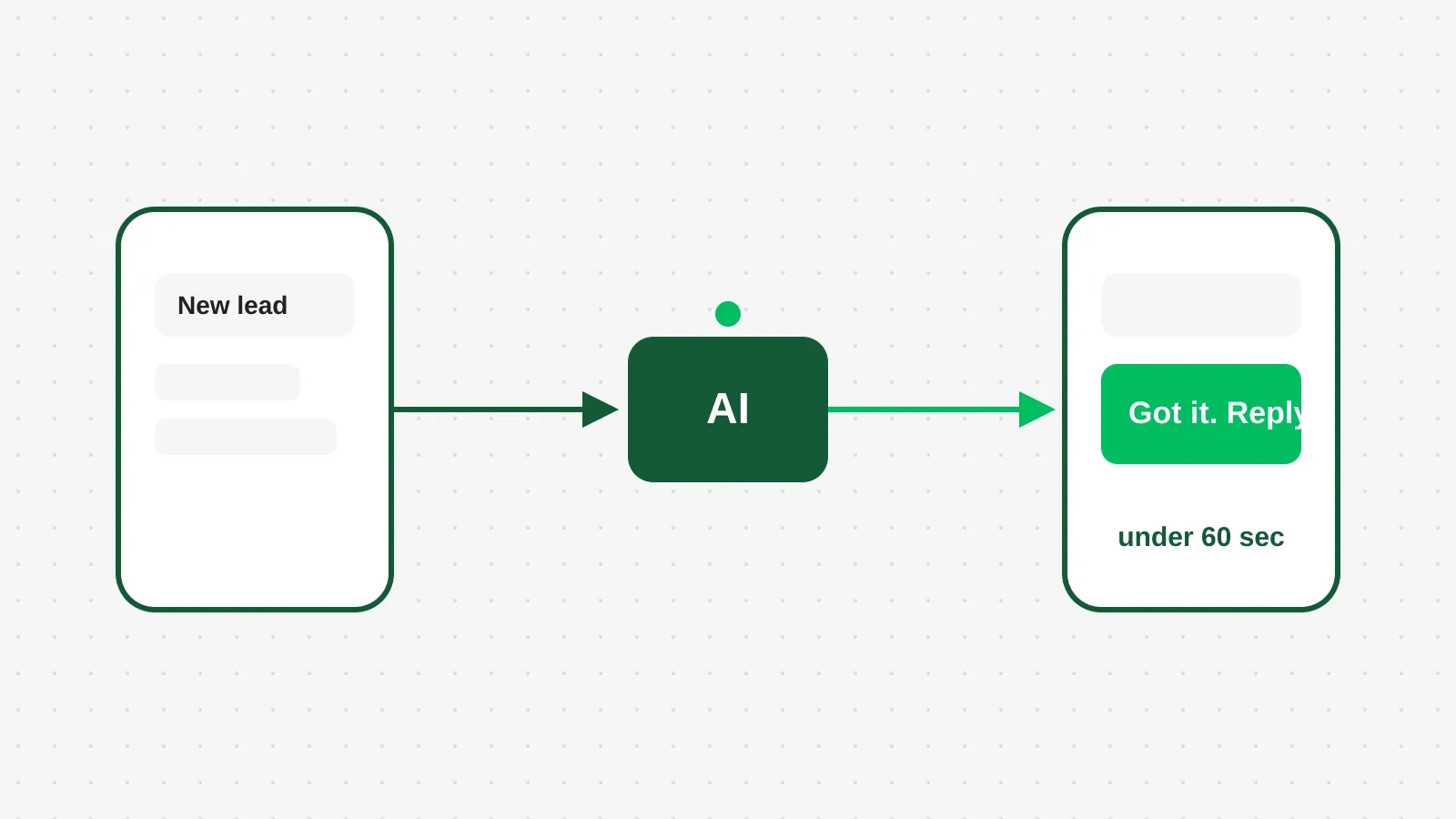
A new lead comes in, one automation step writes the reply, the lead gets a text back.
Why the reply matters more than the price
Velocify studied millions of leads and found that responding within the first minute lifts conversion by 391%. The study is old, but the direction has not been contradicted. Fast beats good when the other option is silence.
The point of an AI reply is not to close the deal. It is to hold the spot until you or your team can take over. Acknowledge the request, ask one useful question, tell them when a person will follow up.
The math for one reply
Here is a realistic reply. I am assuming these numbers, so change them to fit your business.
- Input: 2,000 tokens. That covers your instructions, a short description of your services and hours, and the lead's form answers.
- Output: 300 tokens, which is a short text message.
On Luna, input costs 2,000 divided by a million, times $0.10, which is $0.0002. Output costs 300 divided by a million, times $0.50, which is $0.00015. Total: $0.00035 per reply, or about 3.5 cents per hundred leads.
On Sol, the same reply is $0.004 for input plus $0.003 for output, or $0.007. That is 70 cents per hundred leads.
At 500 new leads a month, Luna comes to about 18 cents. Sol comes to about $3.50.
The costs that are not on that meter
The model is not the only line item. Be honest about the rest:
- Texting fees. Your SMS provider charges per message, and carriers require registration for business texting. Check your provider's current rate.
- The platform. Make, n8n, or your CRM's workflow builder has its own monthly plan. If you already pay for one, this adds nothing.
- Setup time. Writing the instructions, testing them on ten fake leads, and wiring the trigger is a few hours the first time.
- Bad replies. An AI will sometimes say something wrong. That is the reason to keep the reply narrow.
Notice the order of magnitude. The model cost rounds to zero next to the platform and the setup. When someone quotes you a large monthly fee for the AI part alone, ask what the rest of the price is buying.
Which model to pick
For this job, start with Luna. The reply is short, the rules are simple, and volume is the thing that adds up. Move to Sol only if Luna's replies read wrong on your test leads, such as a complicated service menu or leads who write long, messy messages.
Whatever you pick, build it so you can swap the model by changing one setting. Prices and model names keep moving. The automation should not have to be rebuilt each time.
This is the same pattern as the speed to lead systems I build for clients: the trigger, the instant reply, and a handoff to a human. The pattern works with any model.
What to do this week
- Pull your last 20 form leads and check how long each one waited for a first reply. Write down the median.
- Write the reply you would want a lead to get, in 60 words or fewer. One acknowledgment, one question, one promise of when a person will call.
- In Make or n8n, connect your form to an AI step with that instruction and a text message step. Set the model to Luna.
- Send ten test leads, including a rude one and one in a language you do not speak. Fix what breaks.
- Turn it on for after hours only. Compare your response time and booked calls after 30 days.
The $3.50 is not the decision. The decision is whether your Tuesday night leads keep waiting until Wednesday.