Where small business owners draw the line on AI
Corey Berg, Fractional Chief AI Officer
- automation
- process
You already trust ChatGPT or Claude to draft an email or summarize a call. You do not trust it to send a wire, negotiate a vendor contract, or decide who gets a raise. Nobody told you to draw that line. You drew it yourself, and it turns out most owners drew it in almost the same place.
A survey out this week put a number on exactly where that line sits, and it says something useful about what to automate next and what to leave alone.
What the survey found
Stax Payments surveyed 500 US small and midsize business technology decision-makers in June and published the results on August 12. The numbers on the upside are strong. 96% said AI helps them make business decisions faster. 95% said it has made them more confident in the decisions they make. And 80% said they have used AI for work they would otherwise have paid a consultant or outside professional to do.
The same survey found a hard limit. Businesses stay selective about where they let AI operate, especially in HR, financial, legal, and compliance decisions. The owners who reported the best experiences with AI were also the ones most likely to keep expanding where they use it. Trust builds on itself once you have proof it works, and it stalls the same way once you have been burned in the wrong spot.
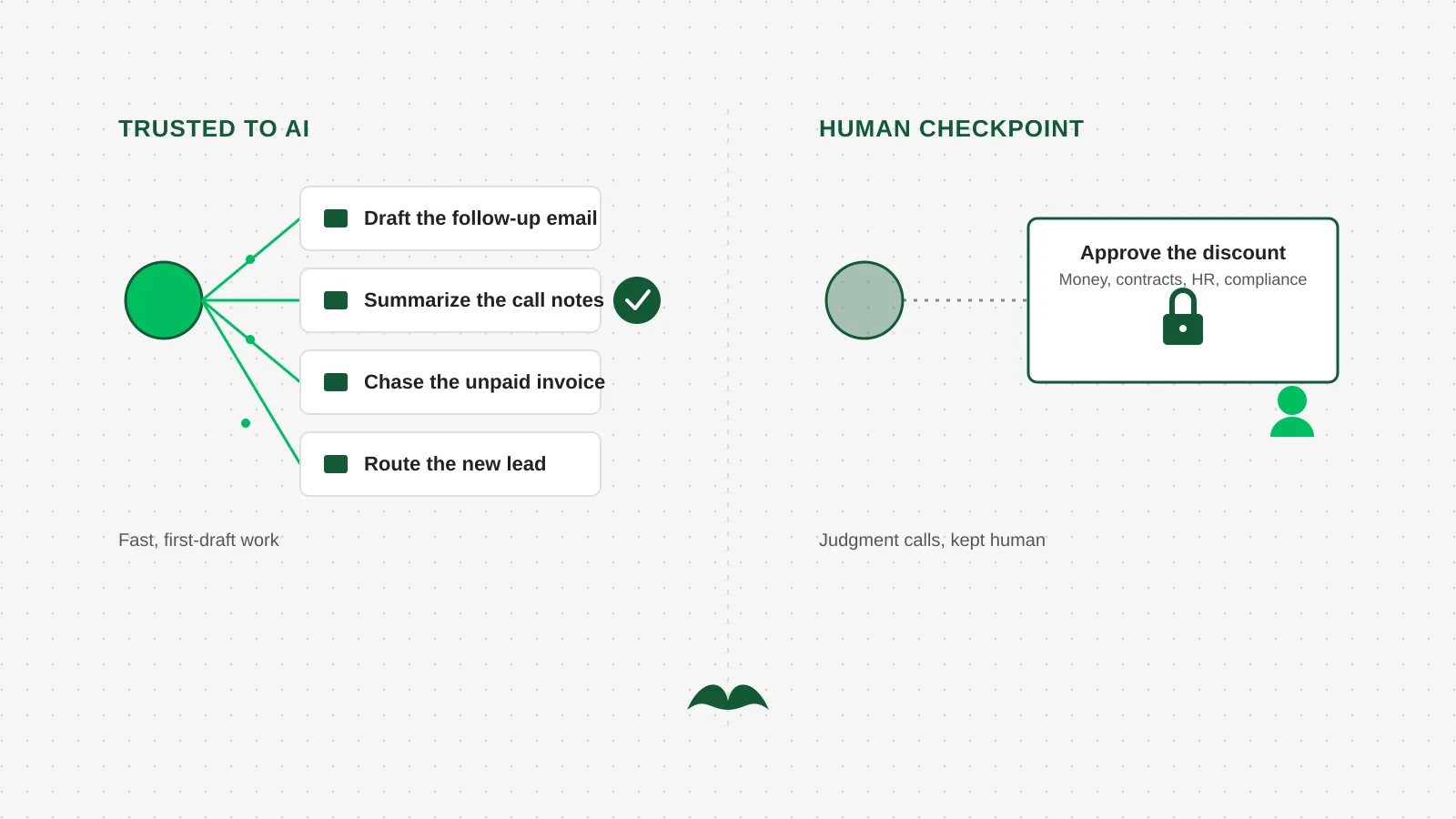 Most owners already sort AI work into two piles without writing it down. The survey just measured where the piles split.
Where founder-led businesses should draw the same line
The survey's split matches what I see sitting with clients between $1 million and $10 million in revenue. Nobody needs convincing to let AI draft a follow-up email, summarize a meeting, or write a first pass at a job description. The hesitation shows up the moment a task touches money leaving the business, a contract term, an HR decision, or anything a regulator could ask about later.
That hesitation is not fear of new technology. It is the same judgment you already apply to a new hire. Give them real work fast, but do not hand them the checkbook in week one.
The mistake I see most often is not misplaced trust, it is misplaced scope. An owner automates the whole intake to invoice chain in one shot, including the step where a discount gets approved, and then loses sleep over the one step that mattered. The fix is not to avoid automating that chain. It is to automate the parts the survey shows the market already trusts, drafting the invoice, chasing the unpaid one, updating the record, and leave the approval as one human click. A speed to lead sequence that replies to a new lead within a minute does not need a person writing each reply. It needs someone checking the pricing and eligibility rules behind it once a quarter, not once a lead.
The honest math
The 80% number is the one worth sitting with. If four out of five decision-makers used AI instead of paying a consultant, that is real money staying in the business. A one-off consulting engagement for something like a compensation review or a process write-up commonly runs $150 to $400 an hour, and a half day of that is $600 to $1,600. The AI tools doing similar first draft work cost $20 to $200 a month total, whether that is a ChatGPT or Claude subscription or a purpose-built workflow tool.
That is not an argument for skipping the consultant, the lawyer, or the accountant. It is an argument for using AI to get to the point where you walk into that meeting with a draft already done, instead of paying for the first draft too. The survey's own trust gap tells you where the savings stop. Nobody in the data was comfortable letting AI make the actual HR, legal, or financial call. Keep that split. Let AI do the first 80% of the writing and thinking, and pay the professional for the judgment call at the end.
What to do this week
- List every task where you or someone on your team currently uses AI to draft, summarize, or research.
- Next to each one, write down whether a mistake there costs you an afternoon, or costs you real money, a client, or a compliance problem.
- Push everything in the first group further into AI without a second thought. For everything in the second group, keep the human checkpoint you already have, and make sure it is a real checkpoint, not a rubber stamp someone stopped reading months ago.