The newest AI models cost more. Here is which one your automations actually need.
Corey Berg, Fractional Chief AI Officer
- automation
- pricing
You have probably seen a headline this week about the smartest AI model yet. Every few weeks there is a new one, and every time, a small voice asks whether your business is falling behind by not switching to it. This week's version of that headline comes with a number worth sitting with before you touch anything.
What actually changed
On September 3, OpenAI launched GPT-6 Astra, its new top of the line model, priced at $10 per million input tokens and $50 per million output tokens. That is two and a half times what its previous flagship, GPT-5.6 Sol, costs at $4 and $20.
Two days earlier, Anthropic (the company behind the Claude AI assistant) shipped Claude Fable 5.1 at the identical rate: $10 in, $50 out. For most of this year, OpenAI and Anthropic have been racing each other's prices down. This is the first time both companies' top model landed on the exact same number, and it is a higher number, not a lower one.
That does not mean AI got more expensive across the board. OpenAI's own workhorse tiers, Terra and Luna, are still priced at $2 and $12, and $0.20 and $1.20 per million tokens after a July price cut. The frontier tier went up. The tier that actually runs most business automation did not move.
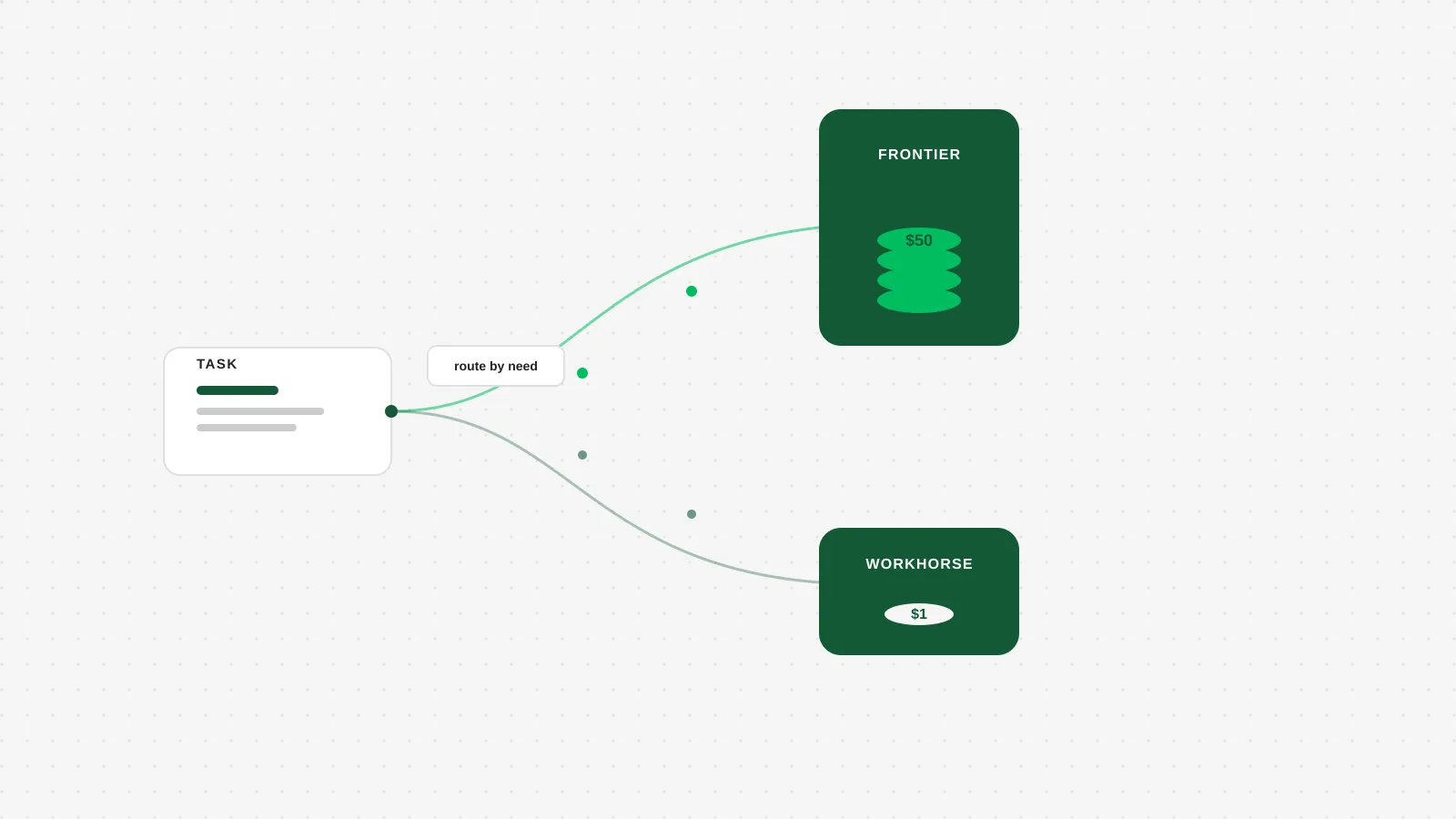 Most tasks route to the cheap node. A few need the tall one.
How a founder-led business actually uses this
The mistake is treating "which AI model" as one decision for the whole business. It is not. It is a decision you make per task, and most of what actually gets automated in a founder-led business does not need a frontier model at all.
Think about what you would actually hand to AI: replying to a routine support question, drafting a follow-up text to a lead, pulling the numbers for a weekly owner brief, checking an invoice against a contract before it goes out. None of that requires the model that can find a security flaw in unfamiliar code. It requires a model that reads a pattern and produces a competent, repeatable answer, which the cheap tier already does.
The frontier tier earns its price on the rare step where the stakes or the ambiguity are genuinely high: a client email that needs real judgment about tone, a contract clause with money riding on the interpretation, a one-off research question nobody has answered before. That is a small slice of the work. Pointing the expensive model at everything, because it is the newest one, is the automation equivalent of hiring your most senior person to file paperwork.
The honest math
Say your business runs a support inbox handling 1,000 conversations a month, each one averaging about 3,000 tokens of context in and 750 tokens of reply out. That is roughly the size of a real customer message plus your policies and order history, not a toy example.
On GPT-6 Astra: 3 million input tokens costs $30, 750,000 output tokens costs $37.50. Total: about $68 a month.
On GPT-5.6 Sol, the previous flagship: $12 in, $15 out. About $27 a month.
On GPT-5.6 Terra, the workhorse tier built for exactly this kind of volume support work: $6 in, $9 out. About $15 a month.
Same 1,000 conversations. The most expensive option costs four and a half times the cheapest one, for a task that does not need the extra reasoning either model is charging for. That gap is not a rounding error. On a small support automation it is the difference between a $15 line item and a $68 one, every month, forever, until someone notices.
What to do this week
Pull up every AI automation currently running in your business, whether you built it, a vendor built it, or it came bundled into a tool you already pay for. For each one, find out which model it actually runs on. Most support tools and CRM add-ons do not advertise this, so you may need to ask directly or check the settings page.
Then ask one question per task: does this specific job need judgment, or does it need to follow a pattern reliably? Pattern work belongs on the cheap tier. Judgment work earns the expensive one. If a vendor cannot tell you which model is under the hood, or cannot let you choose, that is worth knowing before your next renewal, since it is your money paying whatever markup they built in.
This is the same discipline I bring in when I step into a business as its fractional AI lead: match the model to the job, not to the headline, so the automation budget goes toward the work that actually needs the expensive reasoning.